

These are the names of the faces on the newly introduced Ghana cedi notes and the security features
The Governor of the Bank of Ghana, Dr. Johnson Pandit Asiama, has said the newly introduced Ghana Heritage Series banknotes have been designed to last longer, improve security and make everyday transactions more convenient.
The new notes come with enhanced security features to protect them against counterfeiting and make it easier for the public to identify genuine banknotes.
They are designed to withstand Ghana’s climatic conditions and frequent handling, which will help extend their lifespan.
Their smaller sizes is to make them easier to handle and carry, while improving convenience for people who use cash in their daily activities.
They have African symbols incorporated into the design of the currency to help give Ghanaians a stronger sense of pride in the cedi.
The different denominations tell stories about Ghana through images of national heroes, historic sites and cultural symbols.
The designs connect the country’s history and cultural heritage with its present identity as a nation.
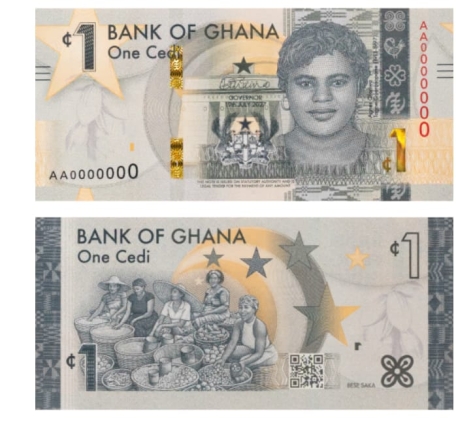
GH¢1 (One Ghana)
Agnes Oforiwa Tagoe-Quarcoopome

It starts with commerce and the start of trading with cowries. On the front of the GH¢1 note features the intaglio portrait of Agnes Oforiwa Tagoe-Quarcoopome (1913–1997), a resourceful market woman and textile trader remembered for the material support she gave to Ghana's struggle for independence.
Affectionately known as "Auntie Oforiwa," she started trading between 1921 and 1929 and, by the 1940s, had become one of the country's most respected traders, operating shops at Makola and Okaishie.
She is credited as the first Makola woman to open a bank account with Standard Bank of West Africa, now Standard Chartered Bank Ghana, at a time when many market women kept their earnings at home. Her example is reputed to have encouraged other traders to trust formal banking. A committed activist, she mobilised Makola market women to finance and support the campaign for independence.
The back of the note features Makola Market, the historic commercial heart of Accra and the pre-eminent setting of Ghana's market-women tradition and an Adinkra symbol.
GH¢2 (Two Ghana)
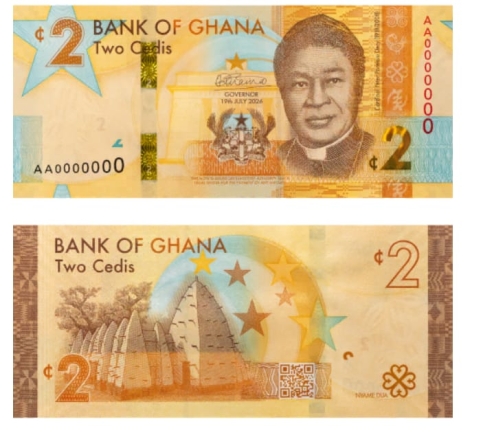
Cardinal Peter Porekuu Dery
The GH¢2 note takes the religious angle of Ghanaians. It has the portrait of Cardinal Peter Porekuu Dery (1918–2008) on the front. He was a prominent Ghanaian prelate of the Catholic Church who served as the Archbishop of Tamale from 1974 to 1994.

He was elevated to the rank of Cardinal by Pope Benedict XVI in 2006 was widely celebrated for introducing local Ghanaian culture and language into Catholic worship, he holds the title Servant of God as his cause for sainthood progresses.

On the back the GH¢2 is the Larabanga mosque, one of eight ancient and highly revered mosques in Ghana and is also the oldest. It is a place of pilgrimage and is considered the Mecca of West Africa. It also has an Adinkra Nyamedua symbol.
GH¢5 (five Ghana)
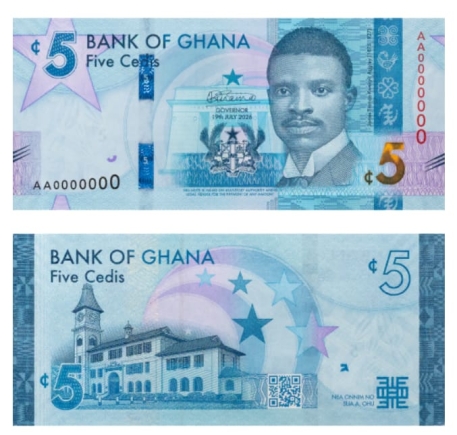
Dr. James Emman Kwegyir Aggrey
The GH¢5 note goes to the educational sector showing the portrait of Dr. James Emman Kwegyir Aggrey (1875–1927), who was a pioneering Ghanaian intellectual, teacher, missionary, and Pan-Africanist widely known as the "Father of African Education."

On the back captures Achimota School and the Adinkra symbol which shows the belief in education, innovation and creativity.
GH¢10 (Ten Ghana)
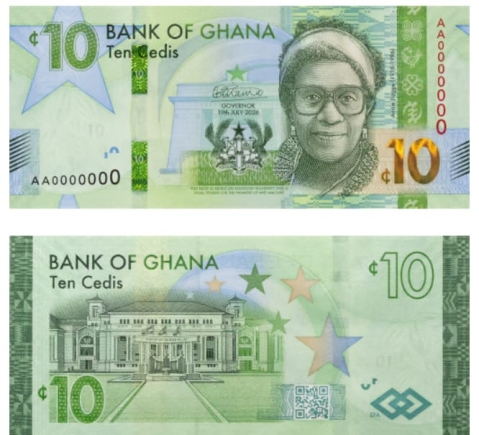
The GH¢10 note goes to the Justice sector and highlights the contribution of women to the Judiciary of Ghana, honouring their trailblazing role.
The front of the note features the intaglio portrait of Justice Annie Ruth Jiagge (1918–1996), a towering figure in Ghana's legal history. Jiagge broke multiple barriers as the nation's first female judge and the second woman in the British Commonwealth to hold a judicial position.
She was a Ghanaian lawyer, activist, and judge who anchored women’s rights in international human rights law

Her distinguished career included serving as President of the Court of Appeal from 1980 to 1983 and becoming the first African President of the World YWCA from 1975 to 1983.
On the back of the note is the Supreme Court building and Adinkra symbol.

Annie Ruth Jiagge (née Baëta) was born on October 7, 1918, in Lomé, a territory formerly part of French Togoland – one of many African colonies under European governance during that period – and now part of the Togolese Republic. At a young age, Jiagge’s parents sent her to live with her grandmother in Keta on the Gold Coast so that she could receive an English education. After junior secondary school, Jiagge studied teaching at Achimota College from 1933 to 1937. The following year, she began her first teaching position at the Presbyterian Girls School in Keta where she quickly rose to the position of headmistress (1940-1946).
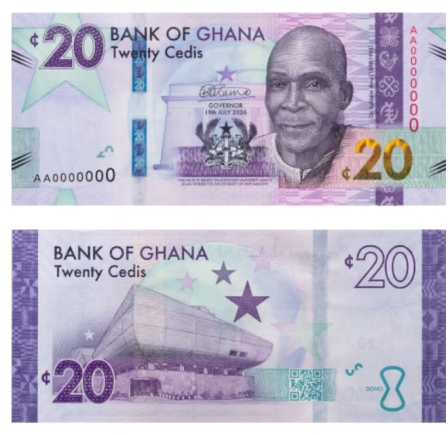
GH¢20 (Twenty Ghana)
Dr. Ephraim Amu. He composed Yen Ara Asaase Ni.
The new GH¢20 Heritage Series banknote features Dr. Ephraim Amu (1899–1995), the renowned Ghanaian composer and musicologist who wrote the patriotic anthem Yɛn Ara Asaase Ni.

This note celebrates his impact on Ghanaian choral music and cultural pride. This marks his return to the currency after previously appearing on the old ¢20,000 note from 2002 to 2007.
On the back of the ₵20 is the National Theatre building.
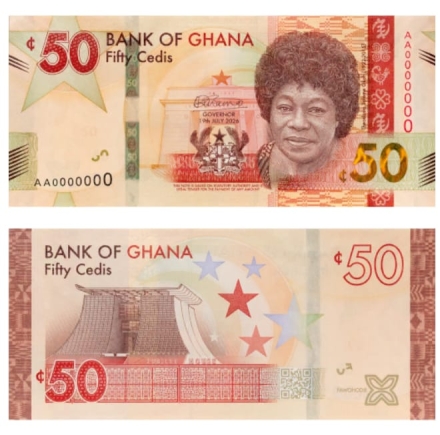
GH¢50 (Fifty Ghana)
Theodosia Okoh. She designed the Ghana flag.

On the back of the note is the Jubilee house, the seat of government and an Adinkra symbol representing nationalism.
- Read also:
- President renders apology to Mrs Theodosia Okoh
- Renaming hockey pitch was a ‘most sad mistake’ – President Mahama
- Hairstyle swap and security features: BoG's full explanation for Theodosia Okoh GH¢50 portrait controversy
- Portrait of Theodosia Okoh on GH¢50 was developed from different photos and not her sister Dr Leticia Obeng - BoG's full explanation
- BoG Board Member Beatrice Annan provides clarification on GH¢50 note and Theodosia Okoh portrait
- Theodosia Okoh's nephew says GH¢50 note portrait is his mother Dr Leticia Obeng, and not the flag designer
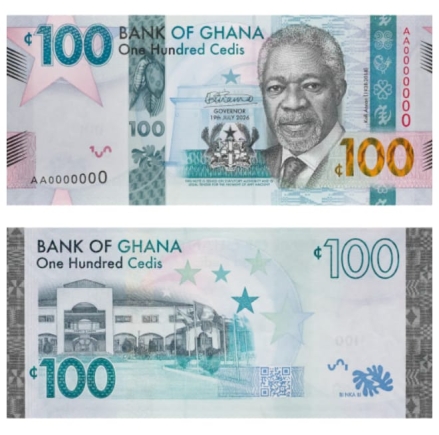
GH¢100 (Hundred Ghana)
Kofi Annan
Kofi Atta Annan (April 8, 1938 – August 18, 2018), a Ghanaian diplomat who served as the seventh Secretary-General of the United Nations from 1997 to 2006 appears on the GH¢100 note. Mr Annan was the first Black African and the first career UN staff member to rise through the ranks to lead the organisation.

On the back is Kofi Annan Peacekeeping Centre and the peace Adinkra symbol.
GH¢200 (Two Hundred Ghana)
Dr Kwame Nkrumah
Kwame Nkrumah (1909–1972), the Ghanaian revolutionary, political theorist, and the founding leader of independent Ghana appears on the GH¢200 note.

Dr Nkrumah led the Gold Coast to become the first sub-Saharan African colony to achieve independence from British rule in 1957, serving as the Ghana's first prime minister and later first president.
On the back of the GH¢200 note is the Kwame Nkrumah Mausoleum and the Adinkrahene symbol.
 .
Email;
