

The Minister of Foreign Affairs, Samuel Okudzeto Ablakwa, has disclosed that Ghana has received formal notice from the United States of America (USA) that it is willing to work with Ghana towards a fair and just world.
Mr Ablakwa commended the US government for this bold step even though it voted against the UN resolution declaring the transatlantic slave trade as the gravest crime against humanity,
Mr Ablakwa was speaking at the Next Steps High-Level Side Event on Reparatory Justice on the sidelines of the 81st United Nations General Assembly in New York last Wednesday.
"I must also use this opportunity to commend the United States of America.
We have received formal notice from the United States of America that even though they voted against this resolution, they are willing to begin to work with us towards that fair and just world we all seek.
So to the sceptics, to the naysayers, to the alarmists, this is your response," Mr Ablakwa stated.
Mr Ablakwa expressed optimism that the formal engagement from the US would encourage other holding nations to join the process, stressing that the Accra Next Steps Commitments were aimed at building, not breaking bridges between Africa, the Caribbean, Europe and the Americas.
He cited a new restitution law signed by US President Donald Trump for the return of Jewish cultural property as a precedent that must be extended to Africa's looted heritage.
The minister said the principle behind the American law — that looted heritage must be returned regardless of where it is held or how long it has been kept-- should apply equally to African artefacts.
“If that principle can apply so beautifully to the Jews and we commend the US for this new law signed by President Donald Trump, we are also deserving of the same principle,” he said.
Background
The law in reference is the Holocaust Expropriated Art Recovery (HEAR) Act of 2025, which President Trump signed on April 13 this year.
The bipartisan legislation permanently eliminates statute-of-limitations barriers that had prevented Holocaust survivors and their heirs from recovering artworks looted by the Nazis.
It allows families up to six years to pursue recovery from the time they identify the current possessor and guarantees that cases will be heard on their merits rather than dismissed on technical grounds.
Repeal laws blocking return
Mr Ablakwa called on nations in Europe that still maintain legal prohibitions on deaccessioning national collections to follow the examples of France and the United States and repeal them.
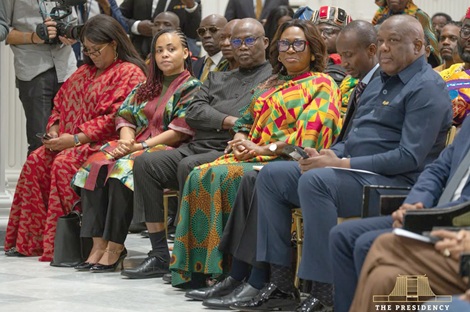
Participants in the Next Steps High-Level Conference on Reparatory Justice in New York, USA
The minister said restitution was not an abstract debate.
"Restitution is very important in this generation. In museums in Europe and the United States of America, in private collections," he said, stressing that Africa's history, carved into sacred wood, cast in royal bronze, woven into Kente and written in manuscripts, remains locked behind glass thousands of miles from its creators.
Reconciliation
Mr Ablakwa stressed that the Ghana-led effort was not intended to create division and assured that the passage of the resolution and the drive for reparatory justice were in good faith.
He said while the subject of reparatory justice remained difficult and emotive, the current generation had a responsibility to forge a new path built on trust and reconciliation.
The Foreign Minister also lauded the Netherlands for cataloguing 2,000 Ghanaian artefacts for return, Germany's engagement with the Kpando traditional area, France's new legislative frameworks on restitution, and the recent return of the Djidji Ayokwe talking drum to Côte d'Ivoire, as examples of progress that must be institutionalised into a permanent global system.
