

On a daily basis, teachers in some basic schools in the Tatale-Sanguli District in the Northern Region juggle many classes, dividing attention between pupils at different stages of learning.
This is because the schools lack adequate teachers, forcing the few available to shoulder the responsibility of teaching multiple classes, impacting attention to pupils.
At Nkpani D/A Primary School, for instance, only two teachers are responsible for seven classes, while at Kandin R/C Junior High School, three teachers handle 10 subjects for more than 100 students.
The shortage is placing a heavy burden on teachers and raising concerns about the quality of teaching and learning in the schools.
A visit to Nkpani D/A Primary School, Kandin R/C Junior High School and Kijomang Primary School revealed that the situation was taking a toll on teachers and pupils, with the few available teachers struggling to attend to the academic needs of pupils across multiple classes.
Beyond the staffing shortage, inadequate infrastructure, furniture and teaching and learning materials are further compounding the challenges facing the schools.
A 2025 report on the state of public basic schools in Ghana, produced by School for Life in collaboration with Eduwatch, put the pupil-teacher ratio in the Tatale-Sanguli District at about 94 pupils to one teacher at both the kindergarten and primary levels.
This is significantly higher than the national averages of about 38 pupils to one teacher at the kindergarten level and 36 pupils to one teacher at the primary level.
Situation widespread
Recruitment challenges
The Director of Education for the Tatale-Sanguli District, Zakaria Masahudu, acknowledged the shortage of teachers, saying about 20 schools in the district relied on one or two teachers to manage their entire school populations.
He said the district received only 16 teachers during the recent recruitment exercise, a number that had not adequately addressed the problem.
He stressed the need for a recruitment policy that prioritised qualified applicants from within the district, saying that people familiar with the area might be willing to accept postings to remote communities.
Teachers overburdened
In an interview with the Daily Graphic, the Headmaster of Kandin R/C Junior High School, Andrews Dawuni, said the school had only three teachers teaching 10 subjects with a student population of more than 100.
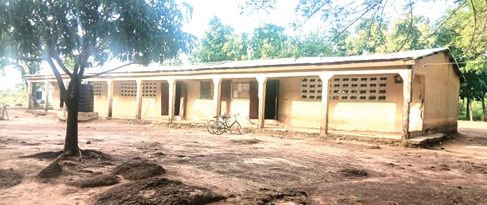
A view of the Kandin R/C Junior High School
He said the shortage had placed an enormous burden on the teachers, particularly on him as headmaster, who also had administrative responsibilities.
“We have tried to share the workload among ourselves, with each teacher handling at least two subjects. However, there are still some subjects that remain unattended,” he stated.
Mr Andrews explained that the teachers had adopted a rotational system to cope with the workload, with each teacher handling a class until the first break before exchanging with another teacher.
The rotation was repeated after the second break until the close of the school day.
He added that “ideally, we should have at least eight teachers, but we are only three, which is far below what the school needs. We hardly get any rest because of the workload”.
For his part, the Headmaster of Nkpani D/A Primary School, Yussif Mohammed, said the school had seven classes but only two teachers, forcing them to combine classes.
He said two community volunteers had joined the teaching staff to support instruction and were paid through community contributions.
He, therefore, appealed for additional teachers to ensure that each class had a dedicated teacher to improve learning outcomes.
Decentralising recruitment
The Director of School for Life (SfL), Sayibu Wedad, called for the decentralisation of teacher recruitment and deployment to give district education offices greater authority to identify vacancies and address staffing gaps according to the needs of individual schools.
She said district education authorities and head teachers were better positioned to identify shortages and should be empowered to declare vacancies and support recruitment processes.
She added that decentralisation would bring decision-making closer to communities and help ensure that schools received the number of teachers they needed.
Incentives for rural teachers
Hajia Sayibu welcomed the government’s announcement of an additional 20 per cent incentive for teachers serving in deprived areas, describing it as a longstanding demand.
However, she said financial allowances alone would not be sufficient to attract and retain teachers in underserved communities.
She, therefore, called for improved accommodation, transport support and attractive award schemes for teachers serving in remote areas.
“The education sector should learn from the health sector, where some community health workers receive support like accommodation and motorcycles to enable them to work effectively in remote communities,” she stressed.
